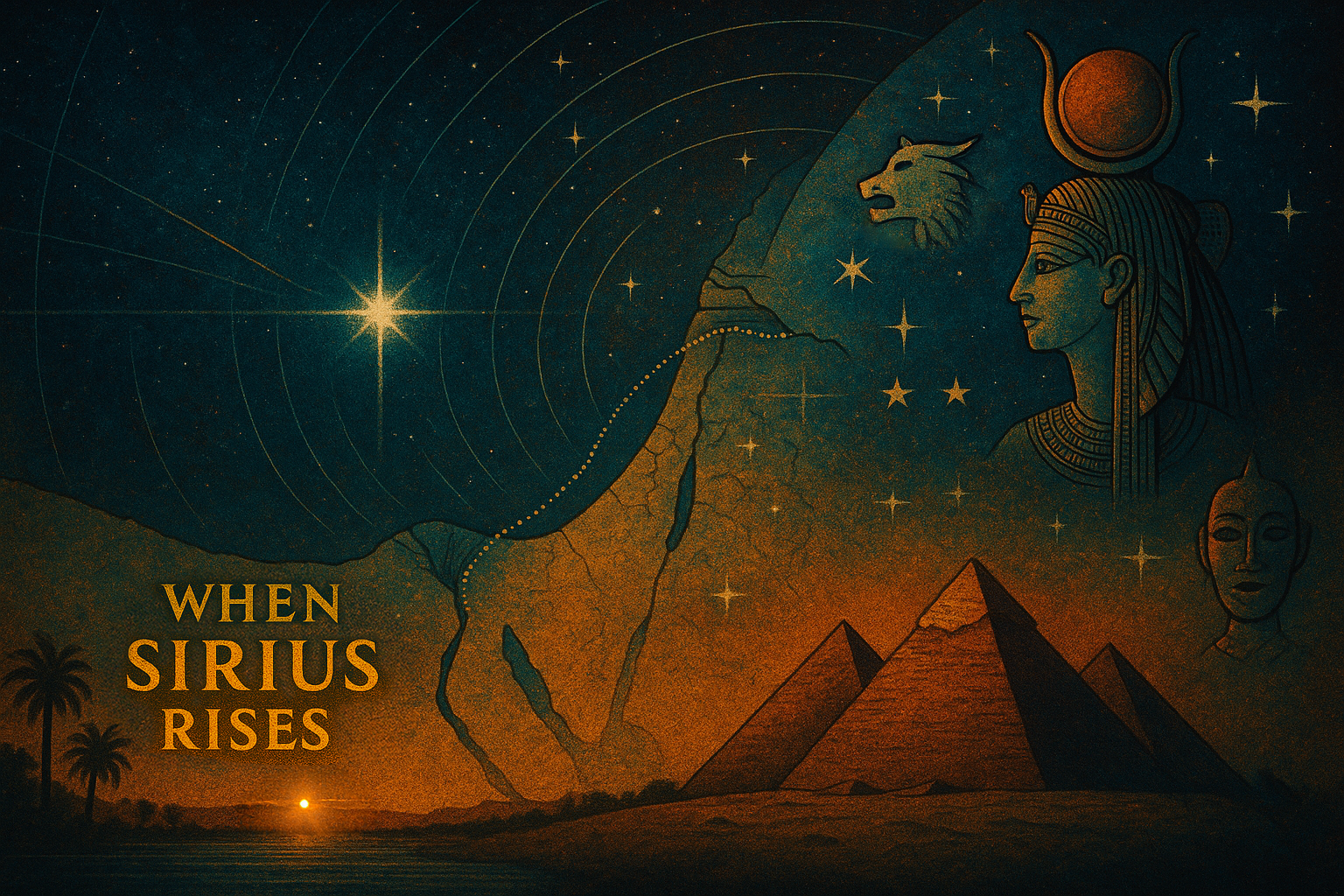
Yesterday, June 22, 2025, might have seemed like an ordinary summer morning on the calendar. But in the astronomical calendar, it marked a significant ancient moment: the solar conjunction of Sirius. On this day, Sirius—the brightest star in the night sky—aligns with the Sun and becomes hidden from view, briefly vanishing behind the Sun’s intense light.
But this celestial event doesn’t mean Sirius has reappeared—quite the opposite. From Earth’s perspective, the star is now directly behind the Sun, invisible at both sunrise and sunset.
Thousands of years ago, however, the ancient Egyptians were already paying close attention to this “silent disappearance,” awaiting the star’s return. Their most important celebration wasn’t held on the day of solar conjunction, but rather during the heliacal rising of Sirius—when the star briefly appears on the eastern horizon just before dawn. That moment was seen as the return of the gods, the awakening of the Nile, and the start of a new cycle of life.
To the ancient Egyptians, stars were not just celestial objects—they were divine, they marked the beginning of time, and they served as a bridge between the soul and the cosmos. Sirius, above all, was the most important among them. As Sirius once again meets the Sun, perhaps it’s a fitting moment for us to follow the gaze of the ancients and look up at this star that has never stopped shining.
昨天是 2025 年 6 月 22 日,一個在曆法上看似平凡的夏日早晨,卻也是天文曆中的一個古老時刻——天狼星合日(solar conjunction of Sirius)。這一天,夜空中最亮的恆星天狼星,正悄悄地與太陽在天空中重合,被熾烈的光芒掩蓋,短暫地消失在我們的視線之外。
不過,今天的這個天文現象並不代表天狼星已經可見,反而正是它最不可見的時刻。從地球的角度來看,天狼星正藏在太陽身後,日出前與日落後的天空中都看不見它的身影。
然而幾千年前的古埃及人,正是以這段「沉默的消失」為起點,等待著天狼星的「重現」。他們最重要的節慶,並非在天狼星合日,而是在之後某天的「偕日同升」(heliacal rising)——當天狼星早於太陽之前升起,在黎明前短暫閃耀於地平線,那一刻,他們相信天神回歸、尼羅河即將甦醒、萬物準備展開新一輪的生命。
在古埃及,星辰是天體也是神的化身和時間的起點,是靈魂與天地對話的橋樑。而天狼星就是那一顆最重要的星。當天狼星再次與太陽重逢,或許也是個好時機,讓我們跟隨古人的目光,重新仰望這顆千年來從未熄滅的星辰。
Who Is Sirius? A Star of Science and Myth
天狼星是誰?科學與神話的雙重身分
Sirius stands out among countless stars for its exceptional brightness. Located in the constellation Canis Major, it’s the brightest star in the entire night sky—often outshining even Mars and Jupiter on clear nights.
Astronomically, Sirius is a binary star system, composed of Sirius A and its faint companion Sirius B, about 8.6 light-years from Earth. Its closeness and strong luminosity make it one of the most prominent and earliest recorded stars in human history.
Nearly every ancient civilization took note of Sirius. The Greeks called it Seirios, or “scorcher,” because it rose during the hottest part of the year. The Romans coined the phrase “dog days” to describe the sweltering midsummer period when Sirius appeared. In ancient China, Sirius was viewed as a fierce warlike star, often associated with military power and unrest.
But among all these cultures, the ancient Egyptians held the deepest reverence for Sirius. Known to them as Sopdet and later linked to the goddess Isis, Sirius was a divine figure, a symbol of time, rebirth, and cosmic order.
In Egyptian mythology, Isis was the goddess of love and rebirth. When her husband Osiris was slain by his brother Set, Isis searched for and reassembled his body to bring him back to life. The disappearance and return of Sirius in the sky echoed this myth, connecting heavenly cycles with stories of divine resurrection.
Thus, Sirius became a “star-god” carrying layers of myth, agriculture, timekeeping, and spiritual meaning—offering a key to understanding the Egyptian worldview.
夜空中有無數閃爍的星辰,但有一顆星,總是比其他星亮得明顯。它就是天狼星(Sirius),位於大犬座(Canis Major)中,也是整個夜空中最明亮的恆星,亮度甚至在晴朗的夜晚能勝過火星與木星。
從天文學的角度來看,天狼星其實是一個雙星系統,由主星「天狼星 A」與伴星「天狼星 B」構成,距離地球約 8.6 光年。也正因為它距離我們相對較近、光度又極強,使得它在地球夜空中熠熠生輝,是最早被多數古文明記錄下來的恆星之一。
在人類歷史中,幾乎沒有一個文明忽略過這顆星的存在。古希臘人稱它為 Seirios,意思是「燃燒者」,因為每年天狼星升起時,正好是酷熱的夏季來臨。羅馬人由此發展出「狗日(dog days)」一詞,象徵炎熱難耐的時節。而在中國古代星官系統中,天狼星的形象是兇猛的戰犬,甚至與北方的軍事、戰神有關,充滿動亂與力量的意象。
但在所有這些文化之中,古埃及人對天狼星的崇拜無疑最為深刻與全面。他們將它稱為索提斯(Sopdet),後來又與更重要的女神伊希斯(Isis)合而為一。這顆星是神祇的化身,是時間的起點,也是生死輪迴的象徵。
在埃及神話裡,伊希斯是愛與重生的女神,而她的丈夫奧西里斯在被弟弟賽特殺害後,便由伊希斯苦苦尋找、拼湊屍體並復活。天狼星在天空中的「消失與重現」,與伊希斯在黑暗中尋找丈夫的神話不謀而合,成為人間季節變化與神界故事交織的節點。
天狼星因此承載著神話、農業、時間與靈魂意義的「星神」。而這樣的信仰,正是我們理解古埃及宇宙觀的入口。

Sirius and the Nile: A Star’s Return and the River’s Awakening
天狼星再次升起與尼羅河氾濫
For the ancient Egyptians, the heliacal rising of Sirius—the day it reappeared in the dawn sky—held profound meaning. It wasn’t just a celestial event; it aligned closely with the annual flooding of the Nile River.
Around mid-July each year, Sirius would rise just before the Sun over the eastern horizon, a phenomenon visible for only a few days and requiring clear skies and keen observation. The Egyptians noticed this event coincided with the Nile’s flooding, which led them to associate the two as cause and effect.
This moment marked the beginning of the Egyptian new year, known as Wepet Renpet, or “opening of the year.” In a society reliant on agriculture, the Nile’s flood was essential to survival. Sirius became the earliest sign of this transformation.
Unlike most ancient calendars based on the Sun or Moon, the Egyptians used a star-based system—making theirs one of the earliest stellar calendars. This was more than a technical choice; it reflected a worldview in which time emerged from celestial rhythms.
Today we rely on instruments to forecast water levels and climate, but for the Egyptians, the reappearance of Sirius was a practical and sacred marker. It structured the farming calendar, guided religious rites, and reinforced royal authority.
對古埃及人而言,天狼星重新出現在黎明天空的那一天,也就是「偕日升」(heliacal rising)具有高度象徵意義。這不僅是一年當中特定的天文時刻,也與整個文明的生產節奏密切相關。
大約每年七月中旬,天狼星會在太陽升起之前短暫出現在東方地平線。這種現象僅會持續數日,且需要清晰的視野與精確的觀察。古埃及人長期以來注意到,這個時刻與尼羅河每年的氾濫極為接近,因此逐漸形成一種穩定的因果觀——天狼星的升起代表河水將至、土地即將恢復生機。
這個觀察,促使他們以天狼星作為新年的起點,稱之為 Wepet Renpet,意即「年度之門的開啟」。對農業社會而言,尼羅河氾濫是維繫生產力與社會秩序的根本,而天狼星則成為這一變化最早的天象指標。
與多數古代文明以太陽或月亮為基準的曆法不同,古埃及是世界上最早以恆星為主要參照點來劃分年份的社會之一。這種以星辰為核心的時間觀,不只是技術上的選擇,更反映出時間與天體節奏的關係。
在現代,我們用科學儀器預測水情與氣候,但對三千年前的埃及人來說,天狼星的日出初見是一個可重複、可驗證、且攸關生存的節點。它讓人們能夠調整農事節奏,也為宗教儀式與國家統治提供依據。天文觀察,從此成為知識、權力與信仰的交匯點。
Stellar Pathways in the Pyramid
金字塔裡的星辰之路
In ancient Egypt, death was not an end but a transition—to a realm among the stars.
A striking example lies in the Great Pyramid of Giza. Inside, two narrow shafts extend from the King’s and Queen’s chambers. Once thought to be air vents, these align with specific stars—Sirius and Orion’s Belt.
Sirius represents the goddess Isis, while Orion’s Belt is associated with Osiris. The shafts symbolized a celestial route for the pharaoh’s soul—to ascend and reunite with the gods.
These weren’t just symbols. The pyramid acted as both tomb and observatory—a structure aligning royal power with cosmic order.
Religiously, Sirius—as Isis—was also the one who reassembled Osiris’s body. Through architectural design, the myth became part of the funeral journey.
To us, the fusion of astronomy and architecture may seem poetic. But for the Egyptians, it reflected how the cosmos was supposed to function—eternal kings must return to the stars.
在古埃及,死亡並不代表終結,而是通往另一個世界的過渡。這個世界並不是在地下,是在星辰之中。
最具代表性的例子來自吉薩高原上的古夫金字塔。在這座巨型石造建築的內部,有兩條特別狹長的通道,從法老墓室與皇后墓室分別延伸出去。早期人們認為這些是通風口,但後來天文學與埃及學的交叉研究顯示,它們對準了天上特定的星辰方位。
其中一條通道的對象就是天狼星;另一條則指向獵戶座腰帶,即與奧西里斯神聯繫的恆星群。這種配置被認為是法老死後靈魂升天的天文引導路線——從王室房間出發,靈魂循著恆星通道上升,最終與神合一。
這樣的設計不只是象徵,而是對宇宙秩序的一種實踐。金字塔不只是墳墓,更像一座天文儀器,是一種將天地對齊、將王權與天體同步的結構。天狼星在其中的角色,不只是照亮夜空的亮星,而是王者靈魂的方向標。
此外,在宗教層面,天狼星所代表的伊希斯,也正是幫助奧西里斯重組靈魂、帶領他重生的神祇。透過建築設計的安排,這段神話被具體落實於墓葬儀式與宇宙想像之中。對古埃及人來說,死亡是一次精密導航的旅程,而星辰就是那套導航系統的主軸。
這種將星象觀念融入建築的概念,在今日看來是詩意又理性的結合。但對三千多年前的埃及人而言,這正是他們認為宇宙應有的秩序——一個王者若要永恆,就必須回歸天上的星辰。

The Sothic Cycle: How Sirius Shaped Egyptian Time
天狼星曆法學:索提克週期與古埃及的時間建構
Egyptians did not measure time in hours and minutes. Instead, they used celestial cycles to understand the flow of the year. Sirius, with its predictable reappearance, became a key marker.
Their civil calendar had 365 days, divided into three seasons and twelve 30-day months, plus five extra days. But without leap years, it slowly drifted from the solar year.
To correct this, they tracked Sirius’s heliacal rising and discovered a repeating pattern: every 1460 civil years, it aligned again with the calendar’s New Year. This is the Sothic Cycle—equal to 1461 solar years.
Even without leap years, Sirius helped them gauge the discrepancy between human calendars and celestial time—and adjust accordingly.
Modern historians also use these records to date ancient events. Mentions of Sirius’s heliacal rising help align fragmented dynasties with known astronomical events.
At a deeper level, this shows that for the Egyptians, time wasn’t man-made—it was revealed by the stars. Sirius embodied the rhythm of the cosmos.
古埃及人對時間的理解,與現代人以小時、分鐘為單位的方式大不相同。對他們來說,時間不是線性的流逝,而是根據天體週期運行所構成的規律。天狼星因其穩定的升起時間,成為他們觀察和調整年度節奏的重要依據。
古埃及民用曆法設計為每年 365 天,分為三個季節(洪水、播種、收穫),每季四個月,每月三十天,年末加上五天的「附加日」(epagomenal days)。然而這套曆法未納入閏年調整,與實際太陽年(約 365.25 天)逐年產生誤差,使節氣逐漸與曆法脫節。
為了因應這種偏差,古埃及人透過長期觀察天狼星的「偕日升」,發現一項重複出現的現象:每 1460 個民曆年,天狼星的偕日升會再次與民曆第一天重合一次。這就是所謂的索提克週期(Sothic cycle),等同於 1461 個太陽年。
這一週期性的對齊,成為古埃及人調整曆法與年度節奏的重要依據。即使他們尚未發展出閏年制度,天狼星的升起卻提供了一種可觀測的方式來評估時間上的偏差,進而修正人為制度與自然節奏之間的落差。
這項發現也成為今日歷史學家推算古埃及歷史年代的重要參照點。透過紀錄中出現的「天狼星偕日同升」,學界能將斷裂的王朝年表對齊於可測的天文事件上,建立起跨越千年的時間序列。
從更高層次來看,天狼星在曆法中的角色不只是功能性的時間標記,也反映出古埃及人對宇宙秩序(Ma’at)的理解。時間並非任意制定的制度,這是一套由天體週期所啟示的節奏,而天狼星正是這種節奏最穩定的象徵之一。
A Star Across Civilizations
天狼星的跨文化意義
Sirius played a major role in Egyptian culture—but it wasn’t unique to them. Many civilizations observed and revered this brilliant star.
In ancient China, Sirius belonged to the “Well” lunar mansion and symbolized war and aggression. Its brightness was read as a sign of upcoming conflict.
In Greece and Rome, it was linked to heat and illness during summer. Hence the term “dog days” became shorthand for that harsh season.
Among the Dogon people of West Africa, oral traditions claimed Sirius had a dense companion star—an idea later confirmed by modern science. Though controversial, it highlights how this star sparked deep cosmological ideas.
Sirius became one of the first stars systematically observed by humans. Across cultures, it marked seasons, structured rituals, and informed calendars.
It wasn’t just a star—it was a shared celestial anchor, connecting astronomy, mythology, agriculture, and memory across civilizations.
天狼星在古埃及的角色固然重要,但它並不是唯一一個賦予這顆星特殊意義的文化。由於它在夜空中的高度可見性,以及每年週期性出現的特性,許多古代文明都將它納入各自的宇宙觀之中,不僅用來指引季節,也寄託各種象徵意涵。
在中國古代,天狼星屬於二十八宿中的「井宿」之一,象徵兇猛、戰爭與征伐。典籍中記載,當天狼星特別明亮或異常移動時,常被視為戰亂將起的徵兆。這與古埃及人將其視為重生與洪水之源的觀點形成鮮明對比,顯示同一顆恆星如何在不同文化背景中產生迥異的意涵。
在古希臘與羅馬,天狼星的升起時間與夏季高溫重疊,因而被聯繫到酷熱與疾病,甚至引申出「dog days」(犬日)一詞,用來描述夏季最熾熱、氣候最不穩定的時段。這種聯想中包含了對自然極端狀態的觀察,也折射出古人對於氣候與身體健康關係的直覺理解。
在非洲的多貢族(Dogon people)中,天狼星則與一套完整的口述宇宙論相連。他們聲稱天狼星其實是一個雙星系統,並有極密的伴星環繞主星運行。這項說法早於現代天文學對天狼星 B 的實證觀測,引發外界關於其知識來源的諸多推測。然而無論其內容是否符合現代理解,這些敘述都顯示出:天狼星長期以來即被視為一種具有特別秩序的天體,其可預測性與規律性往往讓人產生超越日常經驗的聯想。
此外,天狼星也是人類最早開始長期追蹤的恆星之一。它的出現與消失可作為時間點的標記,適用於農事安排、祭祀儀式甚至政治治理。當一顆恆星被不斷記錄、命名、解釋,它也逐漸成為一種文化資源——除了在不同的文明代表不同的神話角色,也是一種跨文化的「知識天體」,同時連接著農業、天文、信仰與歷史。
Starlight and the Meaning of Time
星光與時間的連結
Sirius has never stopped shining. For the ancient Egyptians, it was a sign of rebirth and the New Year. For others, it meant war, heat, or order. Yet in every case, it was tied to time.
Even without instruments, Sirius helped ancient people anticipate nature’s cycles, plan harvests, and legitimize rule. Its importance came not just from brightness—but from meaning.
Today, we don’t set calendars by stars, nor relocate for their rising. But revisiting how cultures once watched Sirius reveals a deeper truth: humans have always looked up, seeking to make sense of time and place.
天狼星的光芒從未熄滅,對古埃及人而言,它象徵洪水與新年,是宗教儀式與曆法週期的核心;對其他文化,它或許代表戰爭、酷暑,或難以言說的秩序與寓意。無論被視為神祇、預兆還是天體,天狼星始終與人類對「時間」的理解緊密相連。
它的出現與消失,讓一個沒有精密儀器的文明,能夠預測河水的來臨、調整農耕的節奏,甚至規劃統治與歷史的框架。這樣的連結並非偶然,而是源於長期觀察與對自然規律的高度敏感。天狼星之所以重要,不只是因為它本身明亮,而是因為它在文化中被賦予了時間、空間與信仰的交會點角色。
在今日,我們或許不再仰賴星辰來制定曆法,也不會因它的升起而準備儀式或遷徙。然而,當我們重新回顧天狼星在不同文化中所承載的意義時,仍能從中看見人類如何以有限的工具,嘗試理解一個運行中的宇宙。