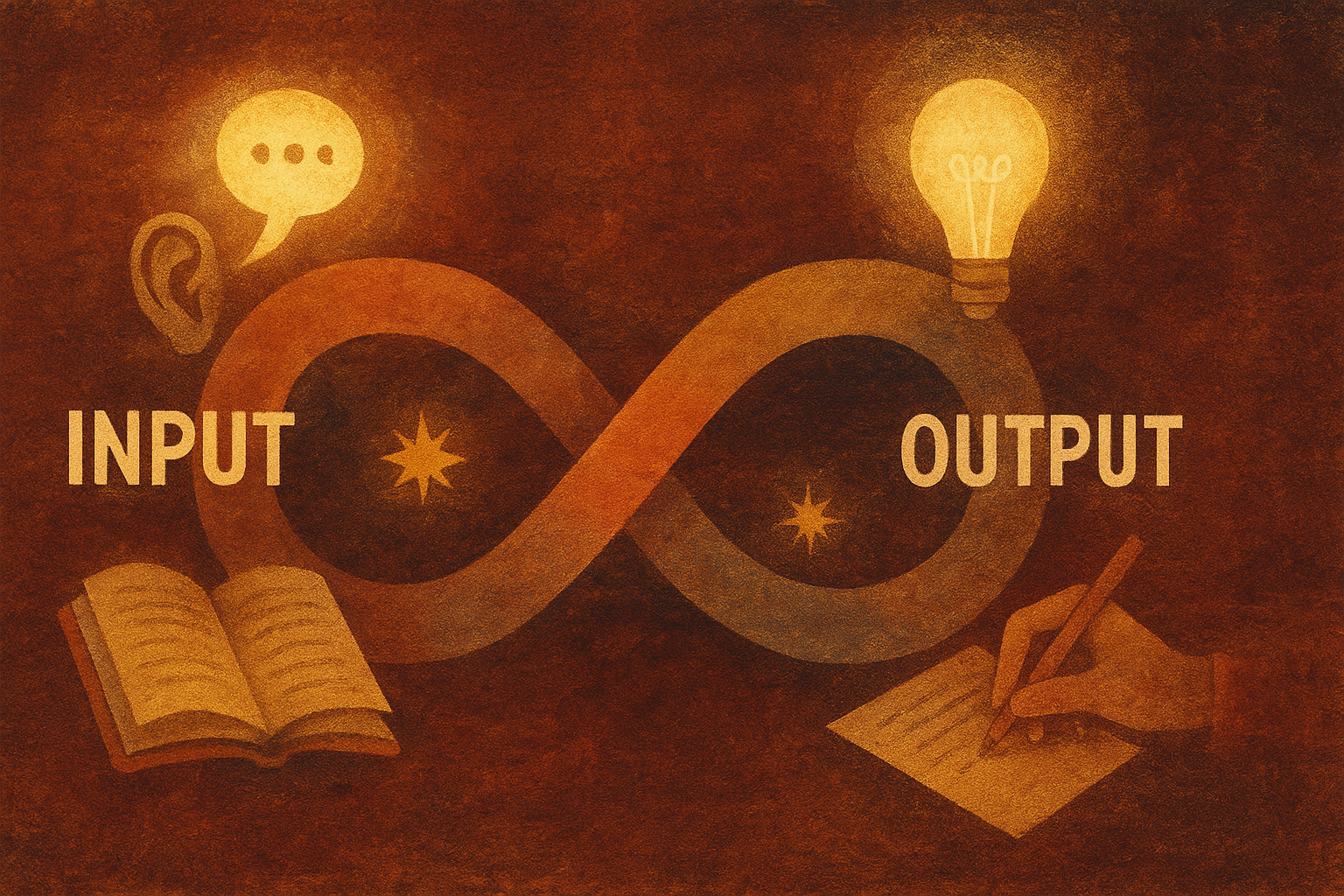
Recently, I realized something: in my interactions with people, I seem to operate according to an “energy management system.” This was not something I intentionally designed; I only noticed recently that I unconsciously use this framework to judge whether a communication feels comfortable to me. Looking at it more broadly, it applies not only to human relationships but also to managing my own mental energy. At the core, this system is simply about balancing “input” and “output.”
最近我意識到一件事:在人際互動中,我似乎是依循一套「能量管理系統」運作。這並不是我刻意設計的,而是前陣子才發現自己在無形之中會用這個框架去判斷交流是否讓我感到舒服。進一步放大來看,它不只適用於人際關係,其實也是我管理自己心理能量的方式。這套系統的核心簡單來說就是「輸入」與「輸出」的平衡。
For me, “input” can mean a lot of different things. It might be having a fun chat, feeling understood, picking up something new in a conversation, or hearing a fresh perspective that connects with my core values in ways I hadn’t thought of before. All of these give me a kind of emotional recharge. On the flip side, “output” is when I share my own thoughts, try to be helpful, offer ideas that might be useful to the other person, or turn what’s on my mind into something more concrete through writing or creating. The balance between the two usually shapes how I feel overall, and whether I feel steady and at ease.
所謂的「輸入」對我來說包含了很多層面。它可能是一場愉快的聊天、被理解的感受、從對話中學到新的知識,或者接觸到符合自己底層價值觀而我從沒想過的新觀點,這些都會帶給我心理上的療癒。相對地,「輸出」則是我把自己的想法表達出來,或者在互動中給予別人幫助、分享一些可能對對方會有用的個人看法,甚至是透過創作和寫東西,把心裡的內容轉化為具體的文字或行動。這兩者的平衡通常會影響我整體的心理狀態,決定我是否能感受到穩定與舒適。
If an interaction involves only one-sided outputting with almost no input, I gradually start to feel exhausted. Especially when both sides need to spend a lot of time understanding each other, I often have to put in extra effort to explain. In such cases, it feels like I am forced to increase the amount of output, but the actual effect doesn’t improve, and my energy easily becomes unbalanced. In interactions—whether I am the one outputting more, or the other person is—I try to engage based on my existing knowledge and understanding, rather than pretending to be enthusiastic or giving superficial responses. I believe this approach allows both our time and effort to be respected.
如果互動只有單方面輸出、幾乎沒有任何輸入,我會感到逐漸疲憊。特別是當雙方需要花很多時間才能理解彼此的意思時,我就需要額外花力氣去解釋。這種情況就像是把輸出量被迫開大,但實際效果並沒有增加,就容易感到能量失衡。在互動中,無論是我輸出較多的情況,還是對方輸出較多的情況,我盡量基於自己已有的知識和理解去投入交流,而不是假裝熱情或表面應付。我認為這樣的方式能夠讓彼此的時間和心力被尊重。
This logic is not limited to any specific type of relationship; it runs through all my interactions. Whether with friends, colleagues, or daily acquaintances, I subconsciously use the balance of input and output to feel the quality of the interaction. I do not expect every interaction to be deep or highly efficient, but there should at least be a two-way flow, where both sides gain something rather than leaving it as a one-sided drain.
這樣的邏輯不會侷限在某一種特定的關係裡,而是貫穿在我所有的人際互動中。無論是朋友、同事,甚至是日常生活中的各種交流,我都會下意識地用「輸入與輸出是否平衡」來感受這段互動的品質。當然我並非是期待每一次互動都深刻或高效,但至少要有一種雙向的流動,彼此都能獲得些什麼,而不是停留在單方面的消耗。
Interestingly, I did not start my blog to manage my energy; I simply wanted to practice self-expression and English in a relaxed way. But over time, I realized that writing itself is a mechanism of energy circulation. When I put my thoughts into words, that is an output; when I review my own writing, organize ideas, or gain new insights, that is input. This process does not depend on others’ feedback, yet it allows me to complete a cycle of output and input internally, gradually becoming an important way for me to maintain psychological energy balance.
有趣的是我一開始寫這個部落格並不是因為想要管理能量,而只是單純想佛系練習表達和英文。但在持續的過程中,我意識到寫作本身就是一個能量循環的機制。當我把想法寫下來時,那是一次輸出;而當我回過頭檢視自己的文字,又能從中整理出新的脈絡或者獲得額外的啟發,那就是輸入。這樣的過程不依賴他人回饋也能讓我在內部完成一個輸出與輸入的循環,慢慢成為我維持心理能量平衡的重要方式。
In conclusion, I see both human interactions and personal growth through the same lens of psychological energy. I am not pursuing high frequency or extremely deep conversations, but rather the balance of input and output. The most comfortable relationships are those where both sides benefit, and I can maintain my own energy balance. This perspective has gradually become an important way for me to understand both relationships and myself.
總結來說,對我而言人際互動和自我成長其實都可以用同一套心理能量的邏輯去理解。我追求的並不是互動的頻率高低,也不是每一次都深刻有趣,而是輸入與輸出的平衡。最舒服的關係是彼此都能有所收穫,而自己也能保持能量平衡的關係。這套觀察也逐漸成為我理解人際、理解自己的重要方式。